
Review · BASEL TOURS
Stories of Basel’s Old Town
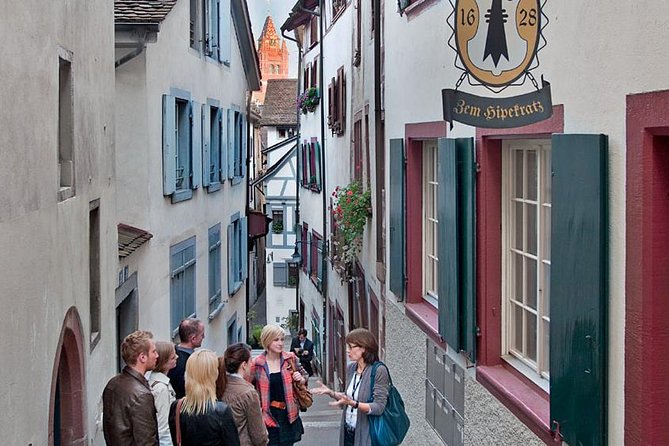
Basel’s Old Town makes quick sense fast. In just 2 hours, you move from quirky public art to major landmarks, learning why Basel looks the way it does. I particularly like the way the route uses story-driven stops instead of a list of buildings, and you also get a strong hit of classic Basel architecture in red sandstone and colorful roofs.
My favorite part is the guides. Names like Doris, Hugo, Susannah, Bea, Jasmin, and Isabelle kept showing up in feedback, and the common theme is clear, friendly storytelling that makes small details matter. The pace is generally described as easy enough that you can actually take it in, not just rush past it.
One thing to consider: this is a bilingual-style experience (English and German), and when groups are larger or noisy, some English-only listeners report spending too much time waiting or repeating. If listening is your top priority, read the practical tips below before you book.
In This Review
- Key highlights you will feel right away
- A 2-hour Old Town loop that gives you bearings fast
- Stop 1: Tinguely Fountain, where public art rewrites a street corner
- Stop 2: Barfüsserkirche and the Historic Museum, church walls that hold collections
- Stop 3: Basler Münster, red sandstone towers and the Mittlere Brücke view
- Museum der Kulturen Basel stop, ethnography with a city-wide perspective
- Marktplatz and the Town Hall, from daily life to local power
- Andreasplatz, shopfront charm, and why the route matters
- English and German on one route, how to make sure you hear what you came for
- Price and value: $33.18 for a guide-led Old Town overview
- Who this is best for, and who should pick something else
- Should you book Stories of Basel’s Old Town?
- FAQ
- How long is the Stories of Basel’s Old Town tour?
- Is the tour offered in English?
- Where does the tour start and end?
- Are museum admissions included?
- Is there food or drink included?
- Is it suitable for kids?
- Is the tour too hard for me if I am not very fit?
- Can I bring a service animal?
- What if I need to cancel?
Key highlights you will feel right away
- Tinguely Fountain first, where Basel swapped an old theater location for playful sculptural machines
- Basler Münster as the anchor, with the cathedral’s red sandstone look and iconic towers shaping the city views
- Museum der Kulturen Basel as a culture stop, not just a photo stop
- Marktplatz and Basel Town Hall to see both everyday life and local government power in one loop
- A guide that actually explains, with frequent mentions of humor and strong site details
- Max 25 people on the walk, which keeps it manageable for a 2-hour tour
Other Basel walks and afternoons
- Basel Farmer’s Market, Cheese, Chocolate & Pastry Tour★ 4.5 · 171 reviews
- Basel City Sightseeing Bus Tour★ 3.5 · 104 reviews
- Basel Historical Old Town Tour★ 4.0 · 99 reviews
- Mt. Pilatus & Lake Lucerne Cruise Small Group Tour | From Basel★ 4.5 · 99 reviews
A 2-hour Old Town loop that gives you bearings fast
This is built for getting your bearings. You cover Basel’s center on foot in about two hours, with a group capped at 25. That size matters. It is big enough to keep the energy going, but small enough that a guide can still point things out at street level, like why a building color looks the way it does or what a square used to be for.
The walk is also designed around major landmarks, but it is not only about stopping at famous spots. You pass through Old Town spaces where everyday life shows up, like the market area, and you get context for why Basel developed the way it did. The tour includes a professional guide, with commentary in English and German.
Practical tip: Basel weather can change quickly. One guide feedback mentioned cold and rain, and the tour still worked. Wear layers you can adjust, and keep your phone battery charged because you will want photos when the red sandstone and roofs come into view.
Stop 1: Tinguely Fountain, where public art rewrites a street corner
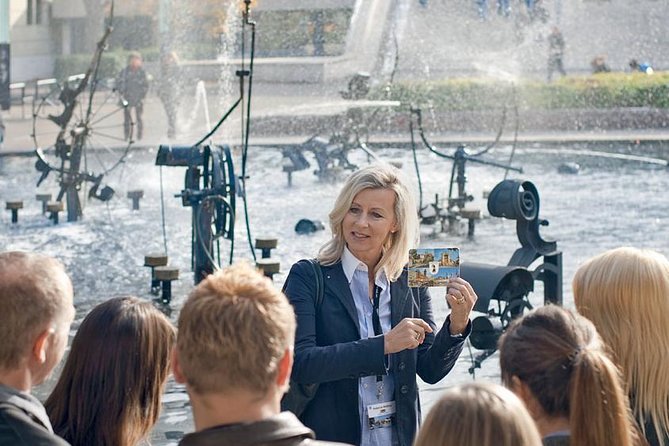
You kick off at the Tinguely Fountain near Klostergasse 7. Jean Tinguely created those sculptural machines in 1977, in a shallow fountain. The detail that makes this stop fun is the location story: it sits where the stage of an older city theatre company once stood.
Why it works on a short tour: it is not an intro lecture. It is a visual hook. Before you even reach the “big cathedral” moment, you get a sense of Basel’s attitude, playful, inventive, and willing to turn a normal spot into something theatrical.
What to do here: take 2 minutes to look, then listen. The fountain is the kind of thing you can walk past on your own, but a guide helps you notice the structure and the intention behind it. If you are traveling with kids, this is usually the kind of stop that keeps attention without needing a long explanation.
Stop 2: Barfüsserkirche and the Historic Museum, church walls that hold collections
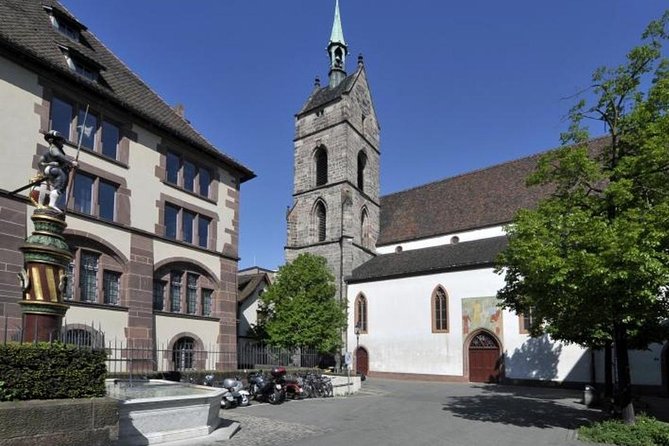
From Tinguely, you move to the Barfüsserkirche. Today, it is home to the Historic Museum of Basel. This stop is short, but it is useful because it shows Basel’s “layering” habit: a building built for one purpose now supports another.
The church structure gives you a built-in sense of how the city changed over time. You are not just learning facts about Basel’s past. You are standing inside a space where the past is physically present, even if you only catch a quick glimpse from the outside.
Possible drawback: if the group is large, this is the kind of stop where you might feel a bit rushed unless your guide is pacing well. If you care about museums, remember that the tour focuses on landmark context. The time here is best used to understand what the museum is and why it matters, not to expect a full museum visit.
Stop 3: Basler Münster, red sandstone towers and the Mittlere Brücke view
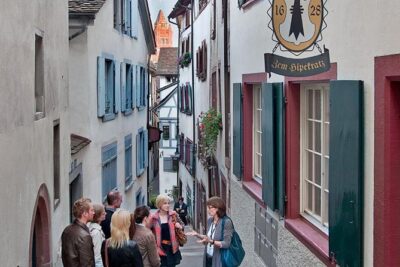
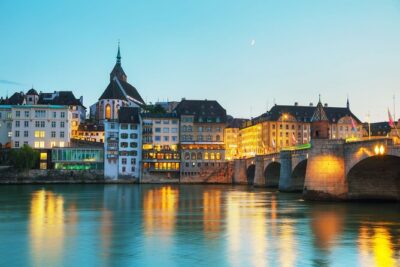
Then comes the star. The Basler Münster (Basel Minster) is paired in people’s minds with the Mittlere Brücke, and your route builds toward that cathedral moment. Expect to notice the red sandstone walls, the colorful roof tiles, and the twin towers that shape the city skyline.
This is also where you will get a “Basel identity” lesson. The cathedral is not only pretty. It gives you the city’s scale and style. Once you understand the Münster, other buildings around Old Town start to make more sense because you can compare textures, rooflines, and materials.
Practical note for your comfort: some feedback mentioned that bilingual tours can split by language around the Münster, and that can create waiting time. If your listening in English is crucial, try to position yourself closer to the guide and stay attentive for the first explanation cycle, because you may get more value if you catch the key points early.
Museum der Kulturen Basel stop, ethnography with a city-wide perspective
The tour also includes a stop for Museum der Kulturen Basel, described as ranking among leading ethnographic museums in Europe. Even if you do not go inside for a deep session during a short walk, this stop adds a useful angle: Basel is not only about medieval corners and cathedral views. It also has a global, outward-facing cultural side.
Why it fits here: ethnographic museums are easiest to appreciate when you already know the city’s “where you are” story. After the Münster and the old town blocks, you can understand why this kind of collection belongs in Basel’s cultural life.
What to consider: the tour time is limited. So if you want the museum visit to be a main event, plan that as a follow-on activity. This stop is best treated as a pointer, showing you where to go next if you want more than street-level context.
Marktplatz and the Town Hall, from daily life to local power
You pass by Marktplatz, with the lively market atmosphere in mind. Even if you are not there during peak market hours, this is the kind of square that helps you picture how Old Town functioned day to day. A guide can connect street layout to movement of goods, local gatherings, and the social rhythm of the city.
Next is the Town Hall, the seat of the Basel government and its parliament. It is eye-catching because it is not shy about personality: a red facade, a characteristic tower, and playful frescoes. This is an important contrast point. After the spiritual and historic stop of the Münster area, you get the “civic Basel” view.
If you like architecture, pause for a quick scan: look up at the facade, then look at the street level around it. That contrast helps you understand that Old Town is not frozen in time. It is still a working administrative and civic space.
Andreasplatz, shopfront charm, and why the route matters
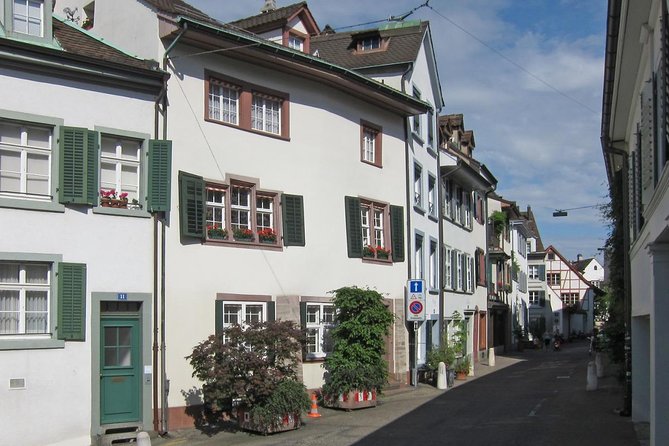
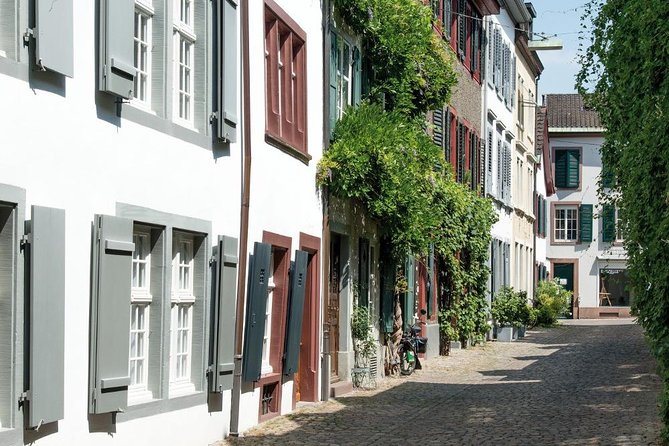
You finish this Old Town loop at Andreasplatz, a square surrounded by small shops and attractive houses. This part of the walk is less about major landmarks and more about atmosphere. It is a gentle landing after cathedral scale and civic buildings.
Why it matters: the best guided walks do not only show you the headline sights. They also show you where people actually browse, linger, and meet. Andreasplatz gives you a sense of what Basel street life feels like after you have learned the “big picture.”
From there, the tour ends near Spalenberg. Your meeting point is Tinguely Fountain, Klostergasse 7, 4051 Basel, and the tour ends at Spalenberg, Basel. If you plan dinner afterward, this is a nice spot to keep walking or hop on local transport, since the area is well connected.
English and German on one route, how to make sure you hear what you came for
This is the one part you should plan for. The experience includes English and German commentary, and feedback includes real stories of how that played out on the ground.
Here is what I recommend so you get the most from your time:
- If you can, choose the tour option that clearly matches your language comfort. One complaint was that English explanations felt shorter than German, with guides repeating content to cover both groups.
- Pick a spot where you can hear. A few comments pointed out difficulty hearing in a crowd, especially when groups are right by street noise or tram areas.
- Stay ready for possible “repeat” moments. One report described the guide doing information twice for different language groups. That can be normal in bilingual setups, but it can reduce how much you see if the group is large or stop transitions take time.
- Ask questions fast. Some guides translated back and forth during the walk, and that is a practical way to get your personal questions answered without losing time.
Bottom line: this tour can be excellent for first-time Basel orientation, but only if the language setup works for you. If English-only listening is your top priority, treat this as a key decision point.
Price and value: $33.18 for a guide-led Old Town overview
At $33.18 per person for about two hours, the big value story is that you are paying mainly for a guide and a structured route. Many of the stop admissions are listed as free on this experience, including the Tinguely Fountain, the Barfüsserkirche museum stop, Basel Minster, and the museum area reference. You are not paying separately to access the key sight points on the walk.
That matters because the tour’s cost is mostly for interpretation. A good guide turns Basel’s landmarks into connected meaning. Feedback repeatedly praised guides for humor, clear storytelling, and showing places you might not have found alone.
When it might feel pricey: if you end up in a bilingual format that reduces how much English you get, the effective value drops. And if you already know Basel, you may feel you could have done similar stops on your own.
One extra value hint from feedback: some visitors said their hotel provided a Basel Card or Visitor card discount and that the on-site price could be lower when purchased at the meeting location. If you have a hotel-provided card, it is worth checking what it covers before you commit.
Who this is best for, and who should pick something else
This tour is a strong fit if you:
- are seeing Basel for the first time and want a quick orientation
- like architecture details like red sandstone, roof tile colors, and tower lines
- enjoy guides who explain stories behind landmarks, including civic and museum-related stops
- want a walk with a pace that is described as not too strenuous for many people
It is less ideal if you:
- want an English-only tour experience and fear bilingual repetition could cut into your time
- dislike waiting or stop time that is affected by group listening needs
- are hoping for a deep dive beyond Old Town, since the route is mostly centered on the Old Town core
Also note: children must be accompanied by an adult. Service animals are allowed. The tour asks for moderate physical fitness, which makes sense for a city walk that stays on foot.
Should you book Stories of Basel’s Old Town?
I would book it if you want a guided, organized sampler of Basel’s Old Town in a short window. The standout benefits are the guide-led storytelling, the smart landmark sequence, and the “you get the city” feeling that comes from mixing cathedral scale with market life and civic power.
Skip it or at least double-check language expectations if you are extremely sensitive to hearing less English, or if you know you get frustrated when a guide has to repeat information for different language groups. If you do book, arrive a little early at the meeting point so you can find a good spot and settle in before the first explanation.
If you are pairing this with museum time, treat Museum der Kulturen Basel as your cue to plan a longer visit later. The walk sets up the why. Your own time inside sets the how much.
FAQ
How long is the Stories of Basel’s Old Town tour?
It is about 2 hours (approx.).
Is the tour offered in English?
The tour is offered in English, and the commentary can be given in English and German.
Where does the tour start and end?
It starts at Tinguely Fountain, Klostergasse 7, 4051 Basel, Switzerland, and ends at Spalenberg, Basel.
Are museum admissions included?
Admission tickets are listed as free for the stops mentioned, including Tinguely Fountain, Basel Minster, and the Barfüsserkirche museum stop.
Is there food or drink included?
No. Food and drinks are not included.
Is it suitable for kids?
Children must be accompanied by an adult.
Is the tour too hard for me if I am not very fit?
It is recommended for travelers with moderate physical fitness.
Can I bring a service animal?
Yes. Service animals are allowed.
What if I need to cancel?
Free cancellation is available if you cancel up to 24 hours in advance for a full refund.
The Rest of the Switzerland Reviews




Basel, Keep Going
Just added to the Switzerland review pile
- The nightwatchman’s secret
★ 5.0 · 3 reviews - Private Transfer Service from Basel to Basel Airport
★ 5.0 · 3 reviews - Engelberg, Cheese, and Mt. Titlis Private Tour from Basel
★ 5.0 · 3 reviews - Private Tour to Zermatt Village and Matterhorn Glacier Paradise
★ 5.0 · 3 reviews - Private Arrival Transfer: from Basel Airport to Zurich City
★ 5.0 · 4 reviews - Pinot Noir & Pinot Wine Tour to Baden-Württemberg
★ 5.0 · 4 reviews
Basel Tours next to each other.
 ★ 4.5Basel Farmer’s Market, Cheese, Chocolate & Pastry TourFrom $112171 reviews
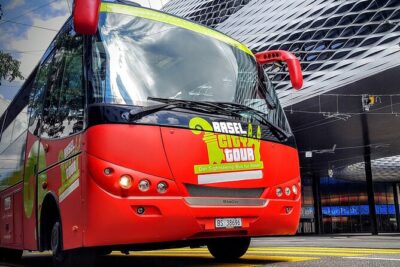 ★ 3.5Basel City Sightseeing Bus TourFrom $34104 reviews
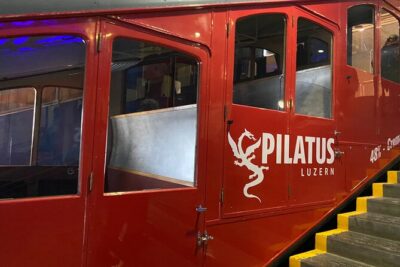 ★ 4.5Mt. Pilatus & Lake Lucerne Cruise Small Group Tour | From BaselFrom $46399 reviews
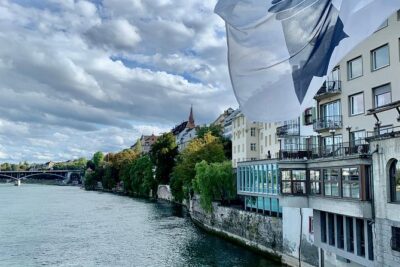 ★ 4.0Basel Historical Old Town TourFrom $2199 reviews
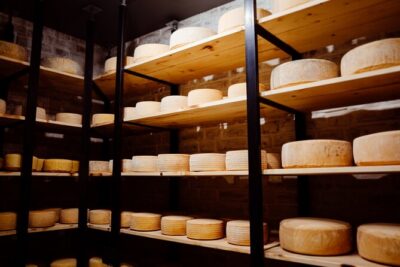 ★ 4.5Swiss Cheese Tasting Experience | BaselFrom $2181 reviews
 ★ 4.5Basel : Private Custom Walking Tour With A Guide (Private Tour)From $7675 reviews
 ★ 4.5Glacier Express, Swiss Alps & Lucerne Tour | From BaselFrom $59767 reviews
 ★ 4.0Swiss Chocolate Tasting Experience | BaselFrom $2550 reviews
Browse the lists this tour appears in