
Review · LUCERNE & LAKE LUCERNE TOURS
Revealing Lucerne: Self-Guided Audio City Tour
Lucerne can be read like a story, one façade at a time. This self-guided audio city tour strings together the town’s most memorable churches, bridges, and painted buildings into a walk you can do at your speed. The best part is how it helps you notice details you might otherwise walk past.
I like the high-quality audio recorded by a professional speaker, plus the clear route guidance with photos and directions. I also like that the route hits a big mix of places, from Spreuer Bridge with its Dance of Death paintings to the emotional Lion Monument finish.
One possible drawback: the tour leans hard into frescoes and mural details. If you want more general city history or faster pacing, this may feel slow or repetitive, since the soundtrack and narration are pre-recorded.
In This Review
- Key things to know before you go
- How the audio tour works, and how to enjoy it
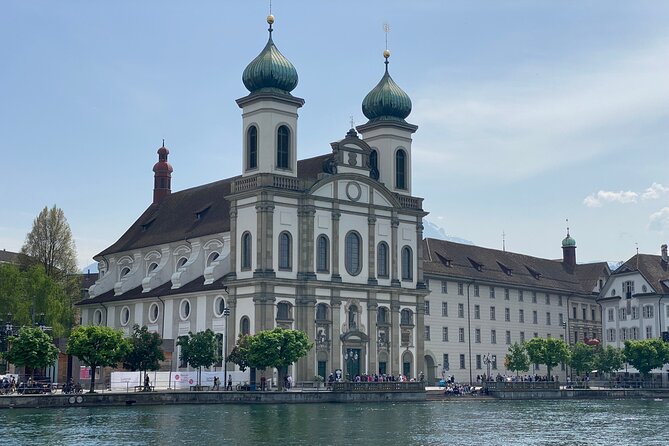
- Jesuit Church Lucerne, the quiet start point
- Ritterscher Palace, success tied to an everyday story
- Franziskanerkirche, a pocket of calm with a religious portal
- Spreuer Bridge, Lucerne’s Dance of Death warning
- Mühlenplatz, where old buildings remember hard lives
- Nölli Tower and the Musegg Wall story
- Weinmarkt, frescoes that include pharmacy and wine
- Hirschenplatz, Goethe, Dornach, and workshop ghosts
- Rathaus Stadt Luzern, civic power and the clock tower
- Wasserturm, the water tower as history
- Chapel Bridge, paintings meant to teach and persuade
- Peterskapelle, St. Niklaus von Flüe and symbolic weight
- Fritschibrunnen, carnival joy and virtue figures
- Hofkirche St. Leodegar, towers, spears, and St. Michael
- Lion Monument, the emotional finish
- Price and value: what $13.29 buys in real time
- Who this tour suits best, and who should think twice
- Should you book Revealing Lucerne?
- FAQ
- What is the price of the audio city tour in Lucerne?
- How long does the self-guided tour take?
- Is the tour audio available in English?
- Do I need to bring my own phone and headset?
- Is there a live guide on this tour?
- Where do I start and where does it end?
- Is this tour private?
Key things to know before you go
- Audio-first route: You rely on your phone and headset for the guide, not a live person.
- Fresco focus: Expect lots of painted façades and detailed explanations about what you are seeing.
- Free entry stops: Every listed stop is marked as admission ticket free.
- Easy start to finish: The walk runs from Jesuitenkirche Luzern to the Lion Monument in about 1 to 2 hours.
- Old Town flavor: The highlights lean toward small churches, civic buildings, and riverside landmarks.
Still on the lake? Other Lucerne reviews
- Mount Pilatus Summit from Lucerne With Lake Cruise★ 4.5 · 1,260 reviews
- Jungfraujoch Top of Europe Day Trip from Lucerne★ 4.5 · 840 reviews
- Lucerne Walking & Boat Tour: The Best Swiss Experience★ 4.5 · 417 reviews
- Lake Lucerne Panoramic Sightseeing Cruise★ 4.5 · 363 reviews
How the audio tour works, and how to enjoy it

This is a private, self-guided walking tour in Lucerne with an English audio guide. You get a link after booking, then use your own mobile phone with internet and your own headset to listen. There is no live guide, so your “tour control” is your walking pace and when you pause to look.
The design is simple: you start at Jesuitenkirche Luzern, Bahnhofstrasse 11A (6003 Luzern) and finish at the Lion Monument, Denkmalstrasse 4 (6002 Luzern). The route is built around short stops, many of them only a few minutes, which keeps you moving through the Old Town without turning it into a long hike.
Because it is pre-recorded, you should go in with the right expectations. You will hear the same narration in the same order, so if you dislike lots of mural talk, choose your listening moments carefully at each stop.
Jesuit Church Lucerne, the quiet start point
Your tour begins at the Jesuit Church Lucerne. From the outside you get that classic church façade look, but the payoff is inside, where Baroque style takes over. Expect to spend a few minutes admiring the spiritual, ornate interiors before moving on.
Why this start works: it puts you in a “looking mode.” The tour then keeps rewarding you for noticing details rather than just moving from landmark to landmark.
Practical tip: since the first stop is short, don’t treat it like a long sit-down. Treat it like an intro, then use the next stops to slow down if a façade or sculpture pulls you in.
Ritterscher Palace, success tied to an everyday story
Next is Ritterscher Palace. What makes it interesting is the contrast between the building’s outward simplicity and the story attached to it. The narration focuses on how a common worker rose to become one of the wealthiest Lucerner figures of the time.
This is a useful kind of history for a walk like this. Instead of only telling you who held power, it gives you a personal “how did people get there” angle.
Possible trade-off: if you mostly want big political events, palace stories can feel smaller in scope. The balance here is that you get lots of small, human-scale stories across the Old Town.
Franziskanerkirche, a pocket of calm with a religious portal
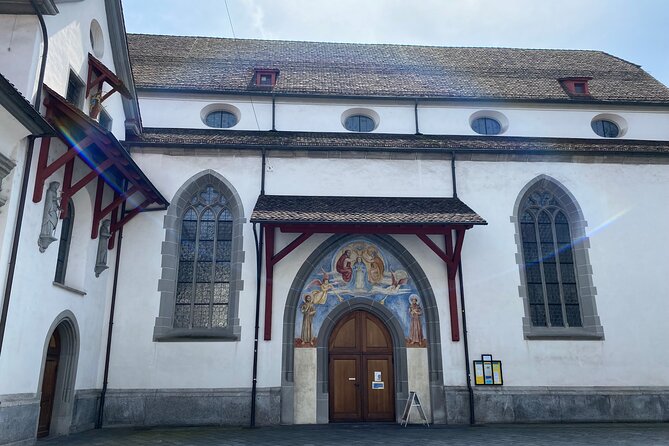
Then you reach the Franciscan Church (Franziskanerkirche). The vibe here is quiet and reflective, and the tour highlights that sense of solitude. Above the entrance, there is a portal scene connected to the coronation of Saint Mary.
This stop is about atmosphere as much as art. Even if you are not a religious-history person, you’ll likely appreciate the way the place invites slower looking.
If you’re short on time, spend enough time to catch the entrance artwork, then move quickly onward. The route is paced so each stop adds one distinct mood or visual theme.
More Swiss days with a guide attached

Spreuer Bridge, Lucerne’s Dance of Death warning
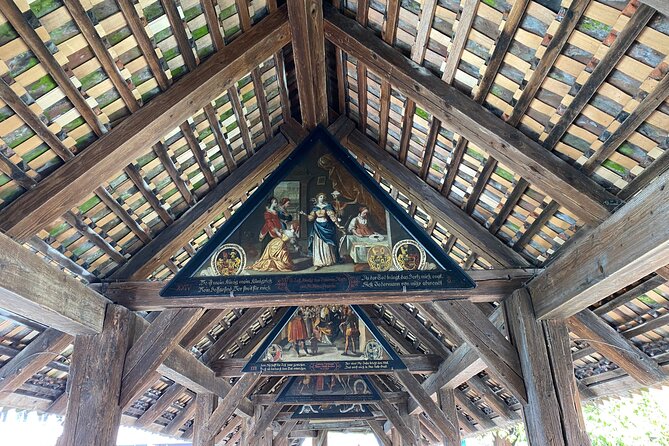
The next highlight is Spreuer Bridge, famous for reminders of death you are meant to face while crossing. The key feature is the Dance of Death paintings, which turn a simple river crossing into a moral and historical message.
This is one of those Lucerne moments where the tour does real value work. It helps you read the bridge paintings as more than decoration. You get a reason for why these images are here, and why people keep returning to them.
Consideration: if you prefer lighter, scenic stops, this one can feel heavy. I think that is exactly why it belongs on the route, but go knowing it sets a serious tone.
Mühlenplatz, where old buildings remember hard lives
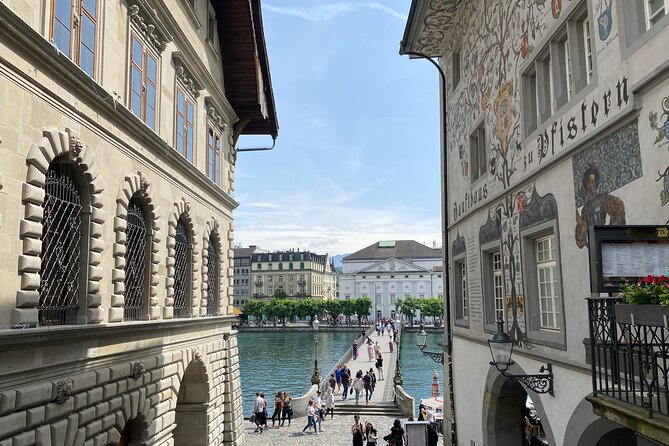
At Mühlenplatz, the tour widens into a cluster of historical sites viewed from a distance. You’ll hear stories connected to:
- a former St. James Hospital that later functioned as an orphanage
- a former prison
- a former brothel
- an executioner’s house
This is the stop that most strongly connects Lucerne’s past to real human hardship. It also shows the strength of the audio format. You don’t have to hunt for every plaque yourself, and you learn what the surrounding buildings used to be used for.
One drawback to flag: because these sites are “observed from a picturesque distance,” you may not get the same close-up detail as you would at a museum. If you love up-front interpretive signage and close viewing, plan to rely on the narration more than your own visual inspection here.
Nölli Tower and the Musegg Wall story
Next is Nölliturm Tower. The guide focuses on the tower’s skyline shape and connects it to the broader story of the Musegg Wall. This is a nice change of pace from fresco-heavy stops because it reconnects you to the idea of city defenses and how Lucerne shaped its edge along the old wall line.
This is also a smart mid-walk landmark. If you’re trying to keep your bearings, the tower silhouette gives you a clear “you are still on track” feeling.
If you’re expecting grand interior access, keep your expectations modest. This is listed as a short stop, so it is more about recognizing the tower and absorbing the story you hear than touring a full complex.
Weinmarkt, frescoes that include pharmacy and wine

At Weinmarkt, you get a concentration of frescoes across the buildings. The narration spotlights specific scenes, including:
- the historic building of the first pharmacy
- artwork showing water into wine
- a depiction connected to Lucerne’s announcement that the city would join the union, tied to the early foundation of Switzerland as a united state
This stop is one of the best examples of why the tour chooses frescoes over random facts. Painted façades become history lessons you can see without paying museum admission.
Possible drawback: if you already know you dislike mural interpretation, this stop will test your patience. The tour expects you to keep looking at painted surfaces long enough to absorb their meanings.
Hirschenplatz, Goethe, Dornach, and workshop ghosts
Then you reach Hirschenplatz, another square packed with frescoed façades. The tour highlights multiple buildings with different themes, including depictions of Goethe, scenes tied to the Battle of Dornach, and a building associated with a former jewelry workshop proprietor.
The useful thing here is variety. Instead of repeating the same type of art story, you get shifts in subject matter, so your eyes have reason to keep moving across the square.
If you want to “manage” mural overload, do this: take one minute to catch the major characters or scene per building, then move. That keeps you engaged without letting one square turn into a slow grind.
Rathaus Stadt Luzern, civic power and the clock tower
Next is Rathaus Stadt Luzern, Lucerne’s town hall. The description emphasizes its medieval charm and the impressive clock tower.
This stop grounds the walk. Up to now, you’ve been bouncing between religious buildings and symbolic art. The Rathaus brings you back to civic life, the public face of the city.
Since this is a short stop, prioritize the clock tower view and the façade feel. Spend longer only if the tour’s narration makes you want to.
Wasserturm, the water tower as history
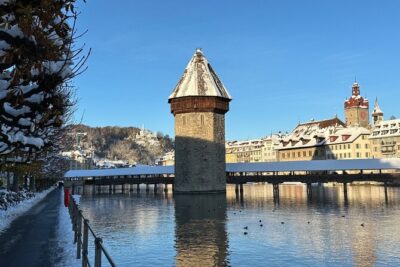
At Wasserturm, you’ll see the tower rising in the river. The narration points out how it looks surrounded by flowing water and ties it to its history, including its use as a prison for unfortunate souls.
This is where your brain gets a “bridge and river crossing” theme going again, similar to Spreuer Bridge. The city’s landmarks are not just scenic. They were functional, and sometimes grim.
If you are feeling museum-fatigued, this stop can still work, because the tower is visible and the story is focused.
Chapel Bridge, paintings meant to teach and persuade
Then comes Chapel Bridge, spanning the Reuss River. The guide describes its famous paintings and notes that the art served purposes beyond decoration, used for education and persuasion.
This stop is a great reminder that Old Town art often had a job to do. It communicated values and messages to people who might not read.
Time tip: Chapel Bridge can get busy visually. The audio narration helps you pick what to look for, so let it guide your attention rather than trying to see everything at once.
Peterskapelle, St. Niklaus von Flüe and symbolic weight
Next is St. Peter’s Chapel (Peterskapelle). The narration calls out two key visual sides:
- the façade showing St. Niklaus von Flüe
- a fresco related to the symbolic burden of the world
This is another stop built for reflection. Even if you do not know the religious figure in advance, the combination of saint imagery and symbolic meaning gives the chapel a layered feel.
If you prefer practical looking over symbolic meaning, you might want to keep your time here tight. The route includes many stops, and this one is short by design.
Fritschibrunnen, carnival joy and virtue figures
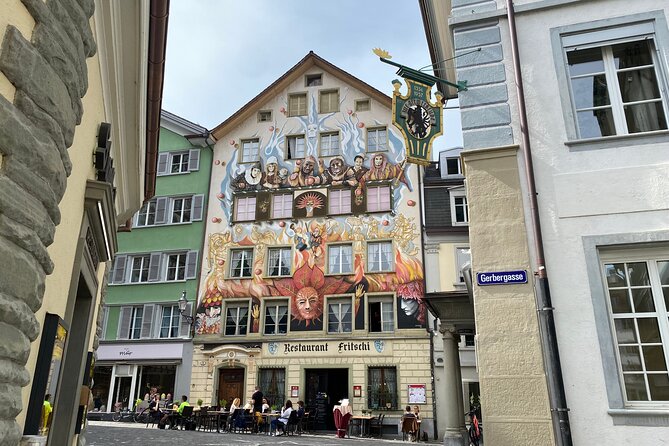
At Fritschi Fountain (Fritschibrunnen), the audio shifts toward lighter street-level themes. The guide points out two nearby buildings with colorful façades:
- one tied to carnival joy
- another showing seven figures symbolizing virtues
This is a welcome palate cleanser after more serious or heavy imagery. It also shows you how Lucerne’s street art isn’t only solemn. It includes social life and moral symbolism together.
Practical note: this is a short stop, so focus on the fountain area first. If the buildings catch your eye, let that curiosity add a minute, then keep moving.
Hofkirche St. Leodegar, towers, spears, and St. Michael
Next is Hofkirche St. Leodegar. The highlights here are visual and dramatic: symmetrical Gothic towers with sharp spears and a depiction of St. Michael vanquishing Satan.
This stop works well if you enjoy religious art with strong imagery. It’s easy to “read” from outside because the story is carried in the shape and the iconography.
If you’re already tired of intense icon scenes, use the narration to pick one element to focus on. That keeps the stop enjoyable instead of overwhelming.
Lion Monument, the emotional finish
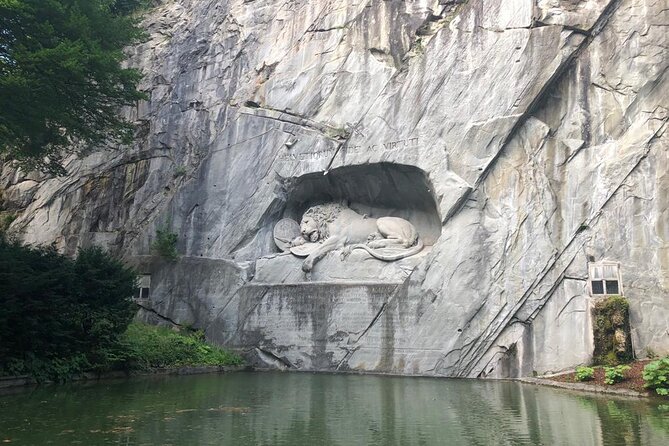
Finally, you end at the Lion Monument. The tour describes the carved sandstone scene of a dying lion that commemorates Swiss Guards who lost their lives during the French Revolution.
This ending earns its place. After a walk full of symbols, you get a clear emotional statement that sticks. It also makes a good final pause point, since it is the tour’s last listed stop.
If you want a clean finish: take a little time here without checking your phone. Let the audio fade and just look at the monument’s expression and scale.
Price and value: what $13.29 buys in real time
At $13.29 per person, you are not paying for a guide’s hours. You are paying for a professionally recorded audio tour with route directions, photos, and stop-by-stop storytelling across the Old Town.
For value, I’d weigh three things:
1) Time efficiency. The whole route is about 1 to 2 hours, and it targets major sights without requiring museum tickets.
2) Interpretation you might miss. Frescoes and façade art can look pretty but mean nothing if you do not know what you are seeing. The audio guide does that matching work for you.
3) Freedom. You can explore at your own pace, stop for a break, and avoid the usual group-pace friction that comes with live guiding.
Where the price might feel less fair is if you dislike fresco and mural analysis. Since the tour explicitly includes over twenty frescoed house stories, that is a central part of the product. If that focus is not your thing, you may feel like the cost bought you more wall-reading than you wanted.
Who this tour suits best, and who should think twice
This walk is a strong fit if you want:
- a self-guided Old Town route that still feels guided through narration
- churches, bridges, and civic buildings tied to specific stories
- fresco and façade art you can follow step-by-step
- an experience you can complete in about 1 to 2 hours
It is not the best match if:
- you want more architecture talk than mural talk
- you dislike slower, detailed narration with a consistent soundtrack style
- you prefer a fast checklist tour with minimal story
Also, consider the tech dependency. Because you need a mobile phone with internet and headphones, this is not ideal if your phone signal or data access is unreliable.
Should you book Revealing Lucerne?
I’d book it if you like walking while learning what you are looking at, especially the painted façades and symbolic bridge art. The route is compact, the story choices are specific, and the audio format gives you control over how long you linger at the places that pull you in.
I’d skip or reconsider if fresco interpretation sounds like a chore. Some people will love having the art explained in detail, and others will find it too much wall-by-wall information for their taste.
If you’re aiming for an Old Town overview that ends with a powerful monument, this tour’s structure makes sense. Just go in knowing it is a story-heavy fresco walk with an audio guide at the center.
FAQ
What is the price of the audio city tour in Lucerne?
The price is $13.29 per person.
How long does the self-guided tour take?
Plan for about 1 to 2 hours.
Is the tour audio available in English?
Yes, the audio guide is offered in English.
Do I need to bring my own phone and headset?
Yes. You need your own mobile phone with internet and your own headset to use the tour link after booking.
Is there a live guide on this tour?
No. There is no live guide, and you explore using the link provided after booking.
Where do I start and where does it end?
The tour starts at Jesuitenkirche Luzern, Bahnhofstrasse 11A, 6003 Luzern, Switzerland. It ends at Lion Monument, Denkmalstrasse 4, 6002 Luzern, Switzerland.
Is this tour private?
Yes. It is described as a private tour or activity, meaning only your group participates.
More Guided Swiss Outings

The Rest of the Switzerland Reviews
Lucerne and Its Lake, Continued

Just added to the Switzerland review pile
- Cheese, Chocolate and Wine in the Bern Region from Luzern
★ 5.0 · 3 reviews - Best of the Uri Alps: A fjord-like lake, glorious peaks and sustainable tourism
★ 5.0 · 3 reviews - Private city tour in lucerne
★ 5.0 · 4 reviews - Touristic highlights of Lucerne on a Private half day tour with a local
★ 4.0 · 5 reviews - Alpine Majesty:Exclusive Private Tour to Mount Titlis from Luzern
★ 4.0 · 5 reviews - Glacier Express Panoramic Train Round Trip in one Day Private Tour from Luzern
★ 4.0 · 5 reviews
Lucerne & Lake Lucerne Tours next to each other.
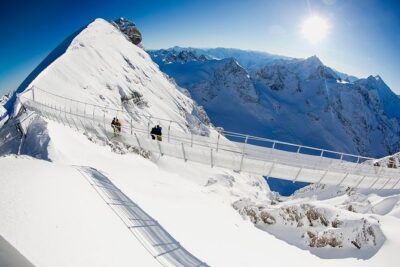 ★ 4.5Mount Titlis and Lucerne Day Trip from ZurichFrom $2151,960 reviews
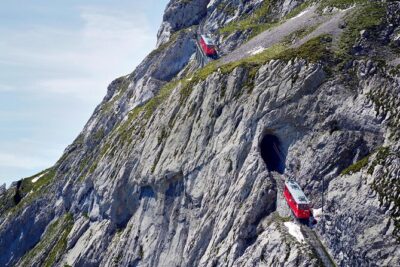 ★ 4.5Mount Pilatus Summit from Lucerne With Lake CruiseFrom $2231,260 reviews
 ★ 4.5Jungfraujoch Top of Europe Day Trip from LucerneFrom $366840 reviews
 ★ 4.5Mt Pilatus and Lucerne Day Trip from Zurich With Lake CruiseFrom $250694 reviews
 ★ 4.5Lucerne Walking & Boat Tour: The Best Swiss ExperienceFrom $118417 reviews
 ★ 4.5Lake Lucerne Panoramic Sightseeing CruiseFrom $39363 reviews
 ★ 4.5Mt Rigi and Lucerne Day Trip from Zurich With Boat RideFrom $204297 reviews
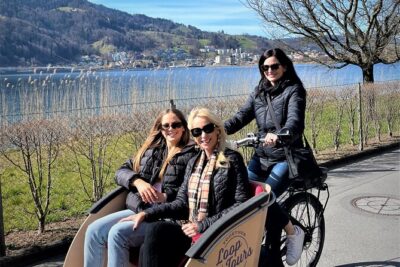 ★ 5.0Lucerne’s Hidden Secrets by Electric Cargo BikeFrom $209288 reviews
Browse the lists this tour appears in